Mahbub Morshed
Translated by Alamgir Mohammad
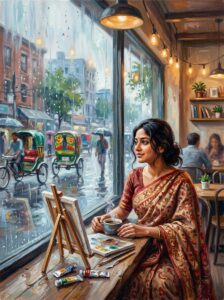
-
A single night’s rain submerged Dhaka city, and my mind kept drifting back to my friend Kaisar. Though to be fair, he couldn’t really be called a friend in the truest sense anymore. Nowadays, we only catch up occasionally, at long intervals. After a brief exchange of superficial updates, we lapse back into months of silence.
Yet there was a time when Kaisar and I were in touch every single day. We used to explore art and culture together. We were likely around the same age, give or take a year or two. Curiously, I always addressed him with the formal apni, using his first name, and Kaisar did the same with me. Whenever there was a painting exhibition, an installation, or a classical music concert, the two of us would go together. We were staples at art-film screenings as well. Almost every evening, we would hang out and chat at the Aziz Super Market. It was a good life. But somehow, imperceptibly, we drifted apart. It took me years to realize that my regular contact with Kaisar had completely ceased. The estrangement seemed to stem from both sides, without any specific incident to blame.
Kaisar began occupying my thoughts from the moment the rainy morning broke. Gradually, so many memories of those old days flooded back that my mind became submerged knee-deep in nostalgia, just as Dhaka city was drowning waist-deep in water.
The rain had started in the early hours before dawn on the first of July, and it showed no sign of stopping. Even while half-asleep, I could tell a torrential downpour had begun outside. The wind howled, rattling against the windowpanes. Yielding to the cozy temptation, I rolled over without leaving the bed, and the cool draft lulled me into a second, deeper slumber.
When I finally got up at nine, I saw that all the surrounding alleys were swallowed by waist-deep water. My Facebook feed was flooded with pictures of waterlogging. People were posting snapshots of a submerged Dhaka from every corner. Students were stranded, unable to reach schools, colleges, or universities. Office-goers stood bewildered on overflowing pavements. Buses, CNGs, and rickshaws looked as though they were on the verge of sinking entirely. The streets in areas like Mirpur, Dhanmondi, and Mohammadpur resembled rushing rivers. People were making memes, photoshopping boats, steamers, and submarines onto flooded streets to troll the situation. Some lamented that plastic would eventually destroy the world.
According to a segment of Dhaka’s residents, discarded chips packets scattered everywhere were the root cause of the waterlogging. Another group argued that it wasn’t chips packets, plastic, or polythene, but rather the systematic filling up of rivers, canals, marshes, and water bodies to construct high-rises that caused the crisis. The government drafts countless plans, claiming every year that waterlogging will be a thing of the past by the next. Yet, the moment heavy rains lash the city next monsoon, the whole town goes under again. Then, government officials and their loyalists deflect, claiming that since citizens refuse to stop littering chips packets everywhere, the waterlogging will persist. They blame plastic and polythene. Yet, the government does nothing to clear the plastic, nor do they take steps to curb its usage. Meanwhile, the opposition and government supporters alike maintain their habit of tossing empty packets wherever they please after eating chips. Consequently, whenever it rains heavily, city dwellers brace themselves for the inevitable deluge. And once it floods, the entire city grinds to a halt for a day or two.
Many years ago, on a similarly rainy day, Kaisar and I had traveled to Dhanmondi, drenched to the bone.
It wasn’t solely the rain that brought that day or Kaisar back to my mind. The true catalyst was Maymuna. Three days ago, Maymuna told me a strange story. Well, not a story, but she shared a real-life incident. Maymuna’s tale revolved around a mysterious painting. As I listened to her, I realized that I already knew another piece of the same puzzle she was describing. If one were to piece them together, it would form an incredible narrative. Yet, I chose to remain a silent listener, keeping my side of the story to myself. I felt it wouldn’t be right to tell Maymuna. But ever since hearing her account, a flood of old memories had been unlocked, and I felt a sudden, urgent need to see Kaisar as soon as possible.
My mind kept wandering back to the events involving Akhtarul Islam twenty years ago, right at the dawn of my professional life. I muttered to myself, What a time that was!
-
Kaisar was supposed to arrive at my office at 5:00 PM. Sitting in my cubicle, I watched through the large glass window. Dense clouds had gathered in the sky. The color of the clouds was a deep, heavy black, yet to me, they looked like thick, curdled white milk swirling across the sky. I couldn’t fathom why this bizarre metaphor kept recurring in my mind. But every time I stared at the dark, impending rain clouds, the image of thick white milk churning in the heavens flashed before me. As time ticked away, the clouds grew heavier, more saturated, and damp. Perhaps, deep within, the friction of water particles was warming them up. Maybe the vast, churning water vapor had made the lower layers of the clouds restless.
Someone remarked, “It’s going to pour today. A proper downpour.”
Secretly, I hoped Kaisar wouldn’t show up. I wished he’d get stuck somewhere or that some excuse would cancel the Dhanmondi trip. The rain was coming; there was no stopping it. As far as the eye could see, there was nothing but clouds. A massive formation of cosmic water vapor hung over the entirety of South Asia like a well-marshaled army. The moment war was declared; it would unleash itself upon the earth like a volley of buckshot.
Would a rain born of such colossal clouds stop easily?
I kept thinking Kaisar wouldn’t make it and that the Dhanmondi trip was off. A part of me nagged with regret over missing such a monumental opportunity. But what could be done? Lost in these thoughts, I was startled when Kaisar arrived precisely on time. Right at 5:00 PM on the dot. The rain had just started outside, and Kaisar stepped into the office half-drenched.
The moment he walked in, he said, “Give me a tissue.”
I handed him the tissue box, and he wiped his head dry.
”We shouldn’t delay at all,” he said. “Let’s go.”
Just then, the heavy roar of the downpour hit my ears. It sounded as if eleven airplanes were continuously circling right outside the office windows.
Trying to discourage him, I said, “Look at that rain. How will we even go in this? I didn’t bring an umbrella, and it looks like you don’t have one either.”
Kaisar countered, “What are you saying, Moin? If we miss this chance, do you think we’ll ever cross paths with Akhtar Bhai again? Will we ever get another appointment? He is foremost among the greatest living artists. Giant stalwarts are lining up just to get a minute with him. Do you think Mithu Bhai will give us another opening?”
Of course, I knew this too. If we miss today, we might never see Akhtarul Islam again in our lifetimes. Mithu Bhai wouldn’t offer another chance, even if he wanted to.
Akhtarul Islam was highly revered by Western art critics. He held shows in New York, Paris, and London. A few years back, the art world had placed him on the list of the greatest living artists. Curiously, one barely heard much about him in Bangladesh. Back in the sixties, during his art college days, he had participated in a group exhibition. To this day, that remains his last exhibition in Bangladesh. It wasn’t that local art circles didn’t know him; those who kept tabs on global trends knew exactly where Akhtarul Islam stood on the international landscape. Yet, the Bangladeshi media never discussed him. The prominent artists here actively avoided uttering his name. Some alleged that local artists envied him and didn’t want anyone in Dhaka discussing his work. Consequently, despite being a Bangladeshi artist, he had been treated like an obscure foreigner for decades. Recently, however, the chatter had suddenly picked up. Last year, Amsterdam hosted a group exhibition on war themes featuring works by the greatest living artists. Akhtarul Islam’s painting there became the talk of the town. Publications like The New Yorker ran dedicated pieces on that single artwork.
Akhtarul Islam painted in the abstract style. He often said that to him, painting was a medium closely related to music; he attempted to create symphonies through his canvases. His war painting was no exception. Yet, many managed to find the essence of Bangladesh in it. It seemed to proclaim, much like the Gita, that war, slaughter, and death are our inescapable destiny. There is no deliverance from it. War, through destruction, births something entirely new—and such was the Liberation War of Bangladesh. Without that war, a new nation wouldn’t have been born. Therefore, if we accept this new Bangladesh, we cannot untangle the war from it.
The discourse surrounding the painting grew so widespread that Bangladeshi art connoisseurs could no longer remain silent. Features on Akhtarul Islam and his art began appearing in weekly news magazines and the literary supplement of Bhorer Kagoj. The newspapers framed the pieces as though they had newly discovered him. The primary theme of their coverage was the irony of how an artist of Bangladeshi origin, wildly celebrated in the West, remained completely unknown in his homeland. They wrote as if they were introducing the artist Akhtarul Islam to the local audience for the very first time. In a way, these reports truly were a discovery. Prior to their publication, let alone the general public, the vast majority of people within literary and artistic circles had never heard of him. Following the articles, intense discussions sparked across Dhaka’s art scene. Sensing a golden opportunity, the Triangle Art Gallery promptly invited him to Bangladesh.
Akhtarul Islam had returned to Bangladesh after thirty-one years. Triangle Art Gallery had granted him a one-month art residency—the highest honor the gallery could bestow. He was to spend this month in Dhaka, residing in a spacious flat in Dhanmondi, where he would paint. He could also spend time at Ahsan Iqbal Mithu’s eco-resort in Cox’s Bazar if he wished. The pieces he produced during his stay would be showcased in a solo exhibition at the Triangle Art Gallery. Akhtarul Islam couldn’t spare more than a month; he had arrived from Paris on June 26th and would leave on July 26th. No matter how much local artists pretended otherwise, burying their heads in the sand, his arrival caused a massive stir in the art community. Not just artists, but major art collectors were rushing to Ahsan Iqbal Mithu, the owner of Triangle Art Gallery. Leading newspapers like Bhorer Kagoj and The Daily Star had already printed his interviews. Although a long queue of heavyweights vied to meet him, Mithu Bhai wasn’t allowing many through. He was a shrewd businessman. Triangle had already incurred massive expenses, and they needed to recoup those costs by selling Akhtarul Islam’s new paintings. If the artist spent his time socializing instead of painting, Mithu Bhai stood to lose out. Of course, if Akhtarul Islam completed even a single painting over the month, it would suffice; Mithu Bhai could fund his entire year’s business on that lone piece. To date, we hadn’t heard of any collector in Bangladesh owning an Akhtarul Islam original. His paintings were far too expensive even for the country’s wealthiest collectors.
I was the one who had pitched the idea of meeting Akhtarul Islam to Kaisar. I had told him it was a rare opportunity for us and that we needed to forge opportunities to spend time with great artists. We would certainly do an interview, but as a prominent contemporary writer and art critic respectively, we also needed to secure some personal time in his company. It was essential to add this rare experience to our portfolios. Though Mithu Bhai turned many away, he couldn’t say no to Kaisar. Among the youth, Kaisar was a crucial voice in art criticism. He commanded his own circle, and Mithu Bhai held a healthy fear of him. Despite being an influential connoisseur, a gallery owner, a collector, and a wealthy industrialist, Mithu Bhai trod carefully around him. Kaisar and his clique were capable of creating a massive uproar in the art and culture scene at any moment.
When I had initially asked if a meeting could be arranged, Kaisar had responded, “But I just met him the day before yesterday. Mithu Bhai hosted a party in the Sheraton ballroom to celebrate his reception in Dhaka. I met him right there.”
”What kind of person is he?”
”Who? Akhtar Bhai? An amiable man, though soft-spoken. He didn’t say much. The pillars of our art and culture scene surrounded him, boasting about his paintings—which exhibition they had seen in Paris or New York, and so on. He just listened intently.”
”I went up, introduced myself, and gave my name. He offered a slight smile. But honestly, what use does he have for my name or identity? He doesn’t operate within a Bangladeshi perspective.”
”See if you can pull some strings for an appointment.”
”There’s no reason why we can’t get one. I just need to tell Mithu Bhai. He won’t dare refuse. You know he’s building a resort in the Garo Hills by grabbing land from the Mandi indigenous people, right? Now, if we raise a stink about how Akhtarul Islam has come to Dhaka under a residency funded by Ahsan Iqbal Mithu—a loan defaulter who usurps indigenous lands—what kind of message will that send to the international press? He won’t have a face left to show. Right? Mithu Bhai knows this well. The Cox’s Bazar eco-resort is built on grabbed land too. Don’t worry, Moin. It’ll happen.”
Stepping out of the office onto the street, we found that Karwan Bazar was already flooded with knee-deep water. From Karwan Bazar all the way to Farmgate, the entire road was swallowed by a vast sheet of water. It felt as though a dormant, subterranean river had finally breached the surface to catch a glimpse of the world above.
I asked, “Has it been raining for a while, or did this much water accumulate just from the shower that started now?”
Kaisar looked at me helplessly. He was still worried that I might stubbornly refuse to go.
”Did this water fall from the sky or did it swell up as a flood from the Buriganga?” I asked again.
There were no CNGs or rickshaws available beneath our office building. Kaisar managed to ask a grocer for two plastic bags.
He said, “Stuff your wallet, recorder, and documents inside these. Let’s start walking.”
Wading through the water, we managed to make it from Karwan Bazar to Farmgate and crammed ourselves onto a Mohammadpur-bound bus. The water came right up to the bus’s footboard. Inside, passengers were packed like sardines, every single one of them soaked to the bone. Dismounting at Asad Gate, we managed to find a rickshaw. The rickshaw plied forward blindly, navigating through the half-submerged roads by sheer guesswork. By the time we reached Akhtarul Islam’s studio-cum-residence via Dhanmondi 27, even our underwear was completely drenched.
Upon seeing us, Akhtarul Islam exclaimed, “What on earth have you two done? Am I an outsider or what? Would I not understand that the city is flooded? You should have called me. You could have called and rescheduled for tomorrow.”
Kaisar chimed in, “Every minute of your time is worth hundreds of thousands, Bhai. Besides, Moin didn’t want to miss out. He insisted that come rain, storm, or earthquake, we absolutely had to meet Akhtar Bhai.”
Instead of responding to Kaisar, he went into the adjoining room and brought out two towels, handing them to us.
He said, “Dry yourselves off and wrap those towels around you. Take off your shirts and pants and leave them under the fan to dry. Listen, make sure you dry your heads properly first.”
As we emerged before Akhtar Bhai, bare-chested, wrapped only in towels, he extended two mugs and told us to make coffee using the water from the thermos flask. “Sugar, coffee, hot water—it’s all there. Help yourselves.”
”What have you guys done, seriously? Everything is drowned out there, isn’t it? How did you manage to come?”
Kaisar narrated our journey. Hearing the descriptions of the submerged city, Akhtar Bhai’s eyes began to spark with a peculiar brilliance.
He said, “To tell you the truth, I’m glad you came. Staring at the rain all alone through the window was making me desperately nostalgic for Bikrampur. It’s been so long since I last visited. Have you two ever witnessed the monsoon in Bikrampur? You haven’t. You won’t find rain like that anywhere else in the world. It pours and pours relentlessly. Rivers, ponds, canals, and marshes overflow. Water crests over the grass. An unending rain accompanied by a heavy wind blowing through dense foliage. Beholding that, your heart will ache with a profound yearning. A rain that awakens a deep, melancholic echo within. If you haven’t seen it, you’ve missed out on something grand.”
”Come, let me show you something interesting.”
Kaisar and I exchanged glances as we followed him into the next room, coffee mugs in hand. Could a man of his stature truly be this simple and warm?
Akhtar Bhai led us to an adjacent room, where an old-fashioned album rested beside a bedside table.
Handing it to us, he said, “Look. Look closely.”
It contained a series of black-and-white photographs.
Light clouds in the sky.
Gradually, the cloud cover spreads.
The clouds thicken.
The sky turns a dense, heavy black.
The rain is on the verge of breaking.
The rain falls.
The clouds shift positions.
Amidst the dense sheets of rain, the clouds vanish from view.
Twenty-one photographs arranged in a meticulous sequence.
Kaisar asked, “Akhtar Bhai, where did you take these photos?”
”These are from Bikrampur. My father had bought me a Yashica camera. I shot them with that. I was in art college back then. Once, during a trip home on a rainy day, I used up an entire roll of film. Do you know how many photos a single roll yielded back then? Twenty-nine. There are twenty-one here. The rest had gone out of focus.”
”Wherever I travel, I keep these photos with me. It’s been thirty-one years since I last saw Bikrampur. Looking at these photos makes me feel as though I’ve returned to that exact day in Bikrampur. Honestly, I had no intention of coming to the country this time either, you see. Your Mithu Miah is like jackfruit sap—incredibly sticky. He’s been pursuing me for years. Whenever he visits Paris, he looks me up. For a long time, he’s been begging, ‘Please come to Bangladesh.’ He frequently calls and whines on the phone. This time, I told him, ‘If I go, I’ll visit Bangladesh during the monsoon. You make the arrangements.'”
Kaisar asked, “Will you visit Bikrampur then?”
”No one lives there anymore. While I was still in the country, my father quarreled with my uncles, sold off all our land, and moved to Dhaka. Now, I imagine that house doesn’t even exist. The village is no longer the same. Will I even find the Bikrampur that I carry around inside my head? The thought of going there frightens me. I am an artist, you see. During that time, I painted a picture of Bikrampur inside my mind. I wander the world carrying that picture. And then I have these few photographs.”
Akhtar Bhai stared wistfully at the album.
”We will take you there,” Kaisar offered.
”Drop it. What’s the use of going to Bikrampur and ruining the old picture painted inside my heart?”
Noticing my silence, Akhtar Bhai turned to me, “Moin, why aren’t you saying anything?”
”I just can’t fathom sitting bare-chested in front of such a legendary artist. I haven’t had the privilege of viewing your paintings in person, only on your website. You aren’t just famous; you are a great master.”
”Oh, come on, stop it. Kaisar told me you are a writer. Listen, as a writer, you shouldn’t count things this way. Whether I am Akhtar or Picasso, at the end of the day, we are all artists. In one sense, all artists across the world are equals. We hold keys to certain mysteries of the universe that others remain blind to. What do you say, Kaisar?”
Like me, Kaisar sat somewhat stunned. He, too, couldn’t wrap his head around how a legendary artist had transformed into an intimate companion within a matter of minutes.
Akhtar Bhai said, “Would you like some cookies? Mithu left a mountain of cookies here. Apparently, a French chef bakes biscuits at a bakery in Gulshan. I couldn’t stop laughing. I told Mithu, ‘What do you take me for, Mithu Miah? I am a man from Bangladesh. Feed me local delicacies.”
Placing an elegant glass jar of cookies on the table, Akhtar Bhai remarked, “If I have to come all this way just to eat things made by a Parisian chef, what’s the point? I have come to my country; I shall eat country food.”
Kaisar asked, “Have you been able to paint anything since arriving?”
Akhtar Bhai replied, “Did I come here to paint? Before arriving, I explicitly told Mithu, ‘Do not pressure me to paint. I have come to witness the monsoon.’ It’s been so long since I last saw a Bangladeshi monsoon. Do you know what Nirad Babu once wrote? The sight of water reminds the expatriate of his homeland.”
I chimed in, “The description he gave of the monsoon in Kishoreganj…”
Delighted, Akhtar Bhai exclaimed, “You’ve read it? We are going to get along famously, you see! Listen, don’t try to conduct an interview today. I’ll grant you an interview another day. I’m in the country for a whole month. We will keep crossing paths. Don’t stress.”
Kaisar observed, “But the essence of water is profoundly woven into your paintings. There is a mystical philosophy to it. One can silently feel the ambience of Bengal’s water and life through your work.”
Akhtar Bhai said, “I never truly left Bengal behind. I carry it with me.”
He pointed to his head, “I carry it right here. If you look at my paintings with a superficial eye, you won’t find anything tangible. There are no figures. No landscapes. Only he who has truly known water will comprehend that water resides there. He who understands the mystical essence of Bengal will find that essence within the colors, within the rhythm of the lines. Europeans remain trapped in a riddle over it. I merely adopted their form. They observe that I deliver the best within their own form. Yet, the moment they attempt to decipher the content, they realize it is alien to them. Where did this emerge from? In searching for answers, they lose themselves within my canvas. If you decode everything instantly, then you’ve simply arrived at a superficial conclusion. The drive to comprehend at a deeper level will vanish from within you. For that, an element of mystery is required. Humanity lives within me. I try to understand human thought. Yet, within me, there exists a paradox of understanding and non-understanding. Perhaps it stems from deep within my core. I cannot fully articulate it myself. You see, Moin, if an artist understands everything completely, it doesn’t work. Some things must be left beyond comprehension. Our calling is to plunge blindly into the deep end. If you cannot play blind, you can never become an artist. If you know everything, you will unconsciously turn judgmental. You will merely become a critic.”
I asked, “Have you truly never painted anything figurative?”
Akhtar Bhai replied, “Well, I aligned myself with the Post-Expressionists. I painted abstracts for a very long time. Now, a blend of abstract and figurative elements is making a comeback. However, I haven’t really painted distinct figures in that sense. By that, I mean the public hasn’t seen any figurative work of mine. For instance, no one has publicly witnessed me executing a portrait. But an artist must keep a few secrets to himself. The whole world assumes you don’t indulge in a particular form, while you continue practicing that very form away from everyone’s gaze. This contradiction always exists within artists. Come, let me show you something.”
Akhtar Bhai ushered us into his studio.
”Mind your towels, boys. What a drenching you’ve had. Though being drenched is exactly how it should be. If you don’t get soaked at this age, when will you? Seeing you two made me long to get drenched myself. What an exquisite pleasure you flaunted right before my eyes. If I were a bit younger, I’d say, ‘Let’s head out again. Let’s go get soaked together.’ But now, fear has taken root. My body no longer recognizes the local water, you understand? Getting wet might bring on a fever. So I held back. But by arriving drenched, you have won my heart.”
The moment we stepped into the studio, we were awestruck. On a massive canvas, the silhouette of a woman was beginning to materialize. Pencil strokes still spanned the entire canvas, save for the throat area, where splatters of color had been laid down.
Kaisar asked, “Is this the sfumato technique? Are you executing a portrait?”
”You boys truly have won my heart. You recognized sfumato at a single glance?”
I remarked, “An art review piece was written about you. They claimed that Akhtarul Islam has never executed a portrait.”
”Forget your art reviews! What did I just tell you a moment ago? Do the words printed on paper carry more weight than my own voice? You believed it simply because it was written in a foreign journal? I have returned to my homeland, haven’t I? I must create something entirely new here. Look closely. Do you recognize the girl?”
Kaisar said, “She looks familiar. I’ve seen her somewhere.”
”Of course you have. Take a look at this notebook,” Akhtar Bhai said, extending his sketchbook toward us. He had already executed nearly fifty sketches of the girl in preparation for this painting. It was evident that he had studied her deeply within a short span of time.
”But don’t breathe a word to anyone. Mithu must not find out under any circumstances, Kaisar.”
”Suhasini Rahman?” I asked, flipping through the sketches.
”Spot on. When I lived in Paris, I regularly listened to Suhasini’s songs. Have you noticed her eyes? Smoky eyes. Large, dreamy, expressive eyes. Whenever you look at them, you’d think they just woke up from sleep. There’s a perpetual smile hovering about her, laced with a shadow of melancholy. Look at that jawline. Even when she isn’t smiling, a faint trace of amusement kisses her chin. Long legs, tall, a fluid, winding figure. I used to think that once I landed in the country, I would reach out to her. You didn’t attend the Sheraton event, Moin, but Kaisar did. I saw Suhasini performing there. I murmured to myself, What a masterstroke that bastard Mithu has pulled. Internally, I was burning with restlessness to speak with her. During dinner, she stepped forward on her own and said, ‘I admire your paintings so much. If only I could paint like you.'”
”I replied, ‘You shall paint. What’s the issue? For the few days I am here, drop by whenever you find time and learn. I shall teach you a few secret techniques.’ I assumed the girl was merely engaging in polite banter. She is a celebrated artist, isn’t she? Arguably number one in the country right now. Am I wrong? Even though I doubted she would show up, I left her my address. I told her, ‘Come after dusk.’ The very next evening, I opened the door to find her standing there draped in a saree. One of the most breathtaking beauties on this planet.”
Akhtar Bhai paused, looking at us. After a brief silence, he added, “She is slated to come over again tonight.”
”In this torrential rain?”
”She promised she would. Apparently, she resides somewhere nearby in Dhanmondi. She is bringing home-cooked steamed Hilsa. If you guys stuck around, you could have joined us. But Suhasini won’t be at ease in your presence. That’s why I can’t invite you to stay for dinner.”
Our conversation with Akhtar Bhai showed no signs of winding down. However, since Suhasini was expected and our presence would only cause her embarrassment, we quickly took our leave from Akhtar Bhai’s apartment and stepped out onto the street.
The rain raged on, now accompanied by gusty, howling winds.
”Has a depression formed in the bay?” Kaisar muttered.
I replied, “Forget your depression! Can you believe Akhtar Bhai managed to charm Suhasini Rahman in such a short time?”
Kaisar remarked indifferently, “Do you have a crush on her?”
”Just a crush? Suhasini is my ultimate fascination. How many of her songs could Akhtar Bhai have possibly heard? I’ve listened to her entire discography. If I don’t listen to her music, my head feels completely hollow. What a voice, what a delivery. She doesn’t sing from her throat like the rest; she sings from the depths of her soul. Can you picture it, Kaisar? On this rain-drenched evening, Suhasini will cook steamed Hilsa with her own hands and ring Akhtar Bhai’s doorbell in a few moments, soaked to the skin. What will Akhtar Bhai do when he sees a rain-drenched Suhasini? He’ll bring a towel and wipe her head with his own hands. He’ll dry her face. He’ll dry her neck. Then he’ll say, ‘Take everything off and wrap yourself in this towel.’ Just visualizing it makes my ears burn hot.”
Kaisar asked, “Are you envious?”
I replied, “It’s not exactly envy. I don’t know what it is. A strange rush of excitement, perhaps. I can see the match is brilliant. A pairing of a great artist with a supreme songstress. Don’t they call it the confluence of the Ganga and the Jamuna? I can’t stop picturing the scenes that will unfold next, Kaisar.”
”What can’t you stop picturing?”
”By now, Suhasini has probably arrived at Akhtar Bhai’s flat. Akhtar Bhai has comfortably settled down to eat rice with that aromatic steamed Hilsa.”
Kaisar countered, “You are overthinking things, Moin. Do you honestly believe Akhtar Bhai is capable of anything at his age? Does the habit even persist past a certain point?”
”What are you saying? He’s lived in Paris since his youth. He consumes the finest fruits of the earth. Did you see his physique? A slight belly, sure, but remarkably toned, wouldn’t you say? He works out morning and night. I suspect the gentleman is still an absolute stallion.”
Hearing such raw language drop from my mouth, the relatively refined Kaisar looked momentarily taken aback.
”That might well be true. But as for Suhasini wading through the rain with steamed Hilsa to visit Akhtar Bhai tonight—I suspect that might not happen after all.”
”What makes you say that?”
”As we were exiting Akhtar Bhai’s alley toward Mirpur Road, did you notice a chocolate-colored Allion driving down the lane? The one with a Dhaka University sticker plastered across its front windshield?”
”No, I didn’t.”
”Naturally, you didn’t. You were entirely consumed by thoughts of how Akhtar Bhai would ravish Suhasini. Suhasini was sitting inside that very car.”
”Are you serious?”
”Yes.”
”Suhasini teaches at Dhaka University now. The moment Professor Ainuddin took charge as Vice-Chancellor, he appointed her to the Guns of Navarone department. It’s a newly introduced subject. Word is, Suhasini shares an exceptionally close bond with VC Ainuddin as well.”
I grumbled, “Kaisar, you are a terrible man. You’ve completely shattered my fantasy. Here I was, romanticizing a symphony of beauty meeting beauty, and you went and injected a ‘Beauty and the Beast’ dynamic into it.”
Kaisar laughed.
”But the Beast in fairy tales isn’t truly a beast. The moment the heroine kisses him, he transforms into a handsome prince. If Suhasini kisses Ainuddin, how long would it take for him to turn into a dashing prince?”
I pleaded, “Just let me think. Suhasini won’t be drenched; Akhtar Bhai will find her perfectly dry when he opens the door. What will Akhtar Bhai do then? Will he pin her against the door? Or will he lead her into the studio, seat her gently, and begin to study the contours of her body as he unwinds her saree?”
-
After much deliberation, I dialed Kaisar’s number. He had long shed his obsession with art criticism to become a full-time architect. He had established his own firm in Banani, and his services were in high demand across the Dhaka market. With his skyrocketing income, he had transformed into an avid art collector. Rumor had it that behind closed doors, his private collection had eclipsed even Mithu Bhai’s. The elite art collectors of Dhaka treated him with immense deference.
The moment he picked up, Kaisar boomed, “What’s the news, writer? You finally remembered me after all this time?”
”I always remember you. But I can never tell whether you’re swamped with work or free.”
”That’s your eternal flaw. You cook up countless assumptions entirely on your own. Why should you lose sleep over whether I am busy or free? Just dial the number.”
”Listen, there’s major news. Do you remember that rainy evening? When we visited Akhtar Bhai’s place?”
”How could I ever forget? I remember every single detail. Including your vivid fantasies. Did this rain remind you of that day? Look at that—even after all these years, Dhaka’s waterlogging remains unresolved. It’s been twenty years, hasn’t it? Yet, the city drowned in rain today just as it did back then.”
”It’s not actually because of the rain. Word has leaked about another portrait executed by Akhtar Bhai. I called to share that with you.”
”What are you saying? Where are you right now? Share your location on WhatsApp. I’ll send my driver to pick you up. Have yourself dropped off ready. We can grab coffee somewhere and sink into the story. And bring a copy of your novel, Bagha Tetul, along with you.”
”There’s water everywhere. My alley is flooded waist-deep. Will the car make it?”
”Don’t worry about it. Just share your location.”
I shaved, showered, and tucked a copy of Bagha Tetul into an envelope. I had just sat down to skim through Facebook when an unknown number flashed on my screen.
”Sir, I am waiting beneath your building. Kaisar Sir sent me.”
Peering through the window, I saw a massive Prado, the size of a minibus, idling downstairs. The waist-deep water had failed to deter the vehicle.
Seated at the coffee corner inside Kaisar’s office, we began our chat over steaming mugs. Kaisar had already placed an order for lunch. He picked up Bagha Tetul and began flipping through its pages.
”I truly admire your novels, Moin,” Kaisar observed. “Your observations on sexuality are profoundly deep. Curiously, while you are wildly imaginative in reality, you remain incredibly grounded in your prose. You handle sexuality with absolute clinical logic.”
”You, on the other hand, are the exact polar opposite. I’ve never seen you exhibit the slightest interest in themes of sexuality.”
Kaisar offered a cryptic smile, “Perhaps a slight shift has occurred of late.”
I offered a subtle smile at his admission.
Meeting after ages, we polished up old memories. We sipped our coffee slowly, gazing at the rain outside. Stray sprays of rain drifted into the coffee corner, kissing the potted pines and ferns arrayed there.
I was burning with impatience to narrate the story of Akhtar Bhai’s painting, but he seemed to take immense pleasure in revisiting the old days. I didn’t mind either; we had plenty of time. The rain had gifted even a hyper-busy man like Kaisar an idle, slow-paced day.
I remarked, “You were always fiercely passionate. It was your absolute focus that allowed us to leave an impression on Akhtar Bhai’s mind. If you hadn’t insisted, we would have never made that journey to Bikrampur.”
Kaisar mused, “Where else will we ever find another maestro of his caliber, tell me? We never saw Picasso in the flesh. But we saw Akhtarul Islam. What an incredibly grounded individual. Yet, what a profound grasp he had on existence. He managed to tilt the entire trajectory of my life in a span of just a few days. Perhaps yours as well.”
Following our initial encounter with Akhtar Bhai, I hadn’t crossed paths with Kaisar for two days. The floodwaters hadn’t fully receded from Dhaka’s streets yet. The city resembled a landscape where a biblical deluge had only just drawn to a close. One could imagine a solitary bird or two returning from afar to Noah’s Ark, clutching a green leaf in its beak, sparking wild ecstasy among all the captive creatures aboard.
The moment the water completely drained, Kaisar marched into my office.
”This Friday, we are heading to Bikrampur. From what I’ve gathered, Akhtar Bhai’s ancestral homestead stands remarkably close to the birthplace of Atish Dipamkar. His paternal cousins still reside there. The two of us are departing for Bikrampur this Friday.”
I hesitated, “We could go, I suppose.”
Kaisar insisted, “We are absolutely going. Friday at the crack of dawn. We must hit Bikrampur before the sun rears its head. Surviving a monsoon sun can be brutal.”
Upon arriving in Bikrampur, Kaisar successfully tracked down Akhtar Bhai’s ancestral home. His two paternal uncles had passed away, and his cousins were well advanced in years, residing in Dhaka. Only a great-nephew of Akhtar Bhai—the grandson of one of his cousins—lived in the village house. Since a local journalist accompanied us, winning the youth over proved effortless. He guided us around the ancient estate. The vast majority of this clan resided overseas; there was hardly anyone left to inhabit the village. Consequently, the house hadn’t suffered much wear and tear. The structures stood frozen in time, precisely as they were when Akhtar Bhai’s father had sold his share to his brothers and departed for Dhaka.
At our prompting, the great-nephew penned a letter to Akhtar Bhai, addressing him as grandfather, extending a warm invitation to visit Bikrampur just once.
When we placed that letter in Akhtar Bhai’s hands, he exclaimed, “What have you two gone and done? You guys are a handful, aren’t you? You’ve completely won me over.”
We had anticipated that the letter would cause Akhtar Bhai to break down into an emotional torrent of tears. He did no such thing.
Instead, he observed, “Accept the joys of existence with the exact same equanimity as you accept its sorrows. Do not weep in the face of bitter agony, nor exult wildly in moments of grand ecstasy. Just as you arrive at fulfillment by accumulating things throughout life, you also arrive there by shedding things along the way. Which balance sheet will you choose to maintain? The ledger of gains or the ledger of losses? Such is life.”
Noticing our fixed stares, he smiled, “So what of it? The decision is finalized. Keep an eye out for a rainy day. The moment skies darken over Bikrampur, the three of us shall depart. Your only task is to monitor if storm clouds are gathering over Bikrampur.”
Observing my frequent glances toward the studio, Akhtar Bhai laughed, “I catch your drift. Brew the coffee and let’s head inside. I’ll show you how far it has progressed.”
The massive canvas was now alive with a riot of color splatters. A foundational layer of paint spanned the entire surface. Amidst those tones, a specific cluster of colors around Suhasini’s throat area cascaded downward, hinting at the swell of her breasts.
Akhtar Bhai noted, “Staring at that now won’t reveal much. Take a look at the sketches instead.” We discovered that Akhtar Bhai had executed a fresh batch of sketches of Suhasini. One particular sketch made my heart skip a beat. Kaisar looked away in sheer embarrassment, unable to meet my eyes. Akhtar Bhai merely smiled, reading our expressions.
Akhtar Bhai had sketched the full, heavy contour of Suhasini’s breasts. The subsequent sketch traced the line from her breasts, cascading past her navel, plunging even lower. Because she always presented herself impeccably wrapped in formal sarees, one could never fathom just how voluptuous and beautifully sculpted her physique truly was.
I mustered the courage to ask, “Is this born of your imagination, or reality?”
Akhtar Bhai countered, “When the real, living subject stands right before me, why on earth would I take refuge in imagination? The girl maintains herself exquisitely. Everything is absolutely flawless. See those breasts? They are precisely this ripe and firm. I haven’t exaggerated a single detail. Not an inch. You are men of art; you will comprehend. After an eternity, I discovered the quintessential Bengali silhouette within Suhasini. The ideal Bengali form. I’ve been hunting for it for ages. You two are gazing at Suhasini’s sketches, while I am witnessing the sheer shock and awe awakened within you at first sight. The painting I shall execute of Suhasini will deliver a lifetime shock to the Bengali psyche. I can predict this simply by reading the expressions on your faces. However, the world will never behold this canvas. I shall hand it over to Suhasini before I depart. If she chooses to unveil it someday, that is her prerogative. But the two of you shall stand as the sole witnesses to this creation. I have reposed my faith in you and made you my witnesses.”
Journeying back from Akhtar Bhai’s residence, the two of us couldn’t stop dissecting Suhasini’s physique. In truth, I was the one doing all the talking while Kaisar listened in absolute silence.
Echoing his skepticism from the previous encounter, Kaisar muttered, “At his advanced age, how much can Akhtar Bhai truly accomplish?”
I asserted firmly, “Did you catch the nuance with which he uttered the word ripe? Can you visualize the precise scenario that unfolded while he executed these sketches? Something substantial definitely transpired. Did you look closely at Akhtar Bhai’s face? A smile of profound gratification played upon his lips. He was deriving a distinct pleasure from flaunting those sketches to us. He was showing two young men exactly how he had captured and savored the form of a songstress they held in ultimate, sacred reverence. Did you fail to notice that?”
Kaisar observed distantly, “Sexuality is a deeply enigmatic and inexplicable phenomenon.”
-
Twenty years after that event, Kaisar echoed the same dialogue. Holding my book Bagha Tetul in his hand, he murmured, “Sexuality is a deeply enigmatic and inexplicable phenomenon.”
I countered, “What brought that on? I recall hearing those exact words drop from your lips ages ago.”
”Beholding you brought that old phrase back to mind. Now, do tell—where did you stumble upon the trail of another painting by Akhtar Bhai?”
I replied, “Do you happen to know my friend Maymuna? I suppose you wouldn’t. She holds a senior executive position at an international NGO. Four days ago, she pinged me on Facebook and said, ‘Could you check out Trina’s wall? Read the piece she’s put up.'”
”Trishita Trina?”
I stared at Kaisar in absolute shock. The man had deciphered the entire riddle from a single clue.
”Yes. Trishita Trina.
”Maymuna and Trina were batchmates at Viqarunnisa Noon School. I met Trina through Maymuna. You know Haydar too, right? The one who used to direct short films. Another friend in our circle is Nayla Chowdhury, the poet. My contact with you has faded considerably over the years, but I still maintain casual hangouts and intellectual chats with this lot. Like the rest of us, Trina reads voraciously. Whenever she finishes a book, she burns with impatience to dissect it.”
”Prompted by Maymuna, I visited Trishita Trina’s profile. Do you recall the era when turning on the television meant encountering Trina instantly? She was the undisputed darling of ad filmmakers.”
Kaisar mused, “Looking at her today, one can scarcely believe how breathtaking she was back then. She has grown so heavy now. It breaks my heart to see her. The girl simply couldn’t preserve herself. She has completely vanished from the audience’s memory. I caught a glimpse of her from up close once back in the day. It felt as though her body had been sculpted out of pure cream. A radiant, golden-yellow complexion. What a commanding presence she wielded. The moment she stepped into a room, no one could look anywhere else.”
Hearing Kaisar describe Trina with such vivid detail surprised me. She had changed drastically over the years.
I continued, “I visited Trina’s profile and found a massive status update. A long paragraph written with broken grammar and fractured sentences—a memoir of sorts. She stated that while she had sat for countless photoshoots over her career and preserved an exquisite collection of her own photographs, no one had ever captured her on canvas. The sole exception was the world-renowned artist of Bangladeshi origin, Akhtarul Islam.”
”The year Akhtar Bhai visited Dhaka, Trina had gone to meet him. She can no longer recall who escorted her to him. But upon meeting her, Akhtar Bhai had remarked that he wished to capture her enchanting countenance on canvas. True to his word, he executed the painting. Before departing for Paris, Akhtar Bhai gifted the artwork to her. Around that time, Nayla, Maymuna, and Haydar were working at Bhorer Kagoj. Though Trina and Maymuna had been school batchmates, they had drifted apart in the intervening years. Trina used to visit Sanjib Da occasionally, and through that channel, her old bond with Maymuna was revived—though it hadn’t matured into the deep intimacy they share now.”
”It was Trina who had approached Maymuna, asking for advice on getting Akhtarul Islam’s painting beautifully framed. Maymuna suggested she hand the task over to Haydar, operating under the assumption that Haydar would assist her with the framing. Haydar exhibited immense enthusiasm. However, after taking possession of the painting, he began stalling indefinitely under the pretext of getting it framed.”
”Trina was a hyper-busy model back then. She likely forgot about it or failed to comprehend the true gravity of the artwork. Yet, whenever she visited the Bhorer Kagoj office, she would press Haydar for updates. Maymuna and Nayla would also occasionally badger Haydar to return the canvas to Trina. Haydar systematically evaded the issue with endless excuses. Eventually, he began claiming that he had lost the painting entirely.”
”In her status, Trina lamented that trusting Maymuna’s advice and handing the painting over to Haydar was a catastrophic blunder. Haydar had gone and lost a priceless original executed by Akhtar Bhai—a loss that remains an unquantifiable void in her life.”
Kaisar interjected, “Can you fathom the astronomical market value of an Akhtar Bhai signed original today? Easily a hundred-million-taka, minimum.”
”After scanning Trishita Trina’s post, I reached out to Maymuna,” I said.
”Maymuna asked me, ‘Have you ever heard of Akhtarul Islam executing a portrait? This is highly likely the solitary portrait he ever produced. And why wouldn’t he paint her? You beheld Trina back then—she was the ultimate sex symbol. Printing her photo on the front page instantly boosted Bhorer Kagoj’s circulation numbers.
”I chose not to reveal anything to Maymuna.”
”I simply asked, ‘Did you ever lay eyes on the artwork?'”
”Maymuna confirmed she had. ‘It was executed in pastels. Beholding the image gives the impression that Trina is emerging from a body of water, though no water body was explicitly painted into the background. Her eyes aren’t locked onto the viewer; they are restless, casting a frantic gaze toward some distant horizon. The Trina everyone recognized was transformed into a mysterious, alien entity on that canvas—bordering on terrifying, even. Akhtarul Islam’s signature rested right at the bottom.'”
I turned to Kaisar, “So the math reveals that beyond the three paintings displayed under the Bikrampur Series during the final week of the exhibition, he had executed two additional pieces. One was of Suhasini Rahman—a canvas whose chances of ever entering the public domain are virtually zero. The other was of Trishita Trina—which has apparently vanished into thin air.”
Kaisar sneered, “Haydar is a common fraud. He knew precisely what an Akhtarul Islam original was worth. He spotted an opening and swiped the painting.”
I pondered aloud, “But was it truly just these two women? Did any other woman gain access to Akhtar Bhai during that month-long residency? Did he execute only these two portraits?”
Ignoring my query, Kaisar mused, “Do you recall the three paintings from the Bikrampur Series? The staggering scale of the canvas Akhtar Bhai chose? No other artist in this country would possess the raw audacity to conceptualize a piece on that scale. The brewing storm of Bikrampur was woven across the entire canvas, yet there wasn’t a single drop of water painted anywhere. No wind was visible. Yet, staring at it made you feel how vividly the past, the clouds, the sky, the rain, the lush green memories, and the present were surging across the frame in a frantic torrent. The three paintings were arranged side by side. Do you remember?”
I replied, “There’s no archiving it away. Those three paintings birthed an indelible image within my mind—one I shall likely carry to my grave. Sublime.”
A heavy silence descended between us. Kaisar appeared to plunge into deep, introspective thought.
When lunch was served, the two of us sat down to eat.
I remarked, “I cross-examined Maymuna relentlessly, trying to unearth how exactly Trina managed to secure an audience with Akhtar Bhai.”
”Maymuna likely assumed I was casually addressing Akhtarul Islam as Bhai out of a habit, despite having no personal acquaintance with him. However, my hyper-fixation on the matter put her on guard. While she shared everything else, I couldn’t crack the puzzle of how Trina landed at Akhtar Bhai’s doorstep.”
Kaisar interjected, “I suspect I hold the key to that. Do you recall a brand named Piko from that era? Piko Biscuits, Piko Chips, Piko Soap. Trina was the star model for their entire line. The chairman of the Piko Group was Didarul Islam, and Trina was his intimate companion. Didarul Islam had purchased one of the paintings from the Bikrampur Series. He had also hosted a lavish party at the Dhaka Club in mid-July to honor Akhtar Bhai. Trina probably crossed paths with Akhtar Bhai at the Dhaka Club. Trina likely wishes to scrub those details from her narrative now. She has transitioned into an intellectual persona today, after all.”
”Maymuna mentioned that reading Trina’s status left her deeply depressed. It felt as though Trina was subtly holding her accountable for the loss of the painting. Yet, Maymuna herself had badgered Haydar countless times, pleading with him to return it. Haydar simply refused to yield. The most tragic variable is that during a casual hangout, Nayla allegedly overheard Haydar boasting that he possessed an Akhtarul Islam original in his private collection.”
Kaisar noted, “As art collectors, we keep tabs on every significant canvas. We know exactly who holds how many Shilpacharyas, where the Sultans are sequestered. The trajectory of Akhtar Bhai’s works is no secret to us. From what I gather, Didarul Islam had purchased Trishita Trina’s portrait from Haydar back during that exact era.
I remarked, “Then Haydar truly is a despicable creature.”
Kaisar countered, “He’s your friend. You operate within the same circles; you’d judge better. Though to my eye, that man is incapable of being anyone’s friend. I’ve rarely encountered an individual so utterly devoid of talent. Do you recall what Akhtar Bhai once observed? Talent, wisdom, observation—all of it functions as an intricate communication system.”
I completed the thought, “—If you can successfully align the sequence, the communication establishes itself. This human connection operates much like an epiphany. It offers a taste of pure liberation.”
Kaisar muttered, “Keep this under wraps from Maymuna or Trina. Besides, it’s wiser not to volunteer too much information. We happen to hold a distinct edge over them in terms of the broader narrative. If you align all the equations, to borrow your raw phrasing, it’s evident that Akhtar Bhai thoroughly enjoyed Trina as well.”
A subtle smile crept onto my face.
Kaisar observed, “You’ve grown remarkably solemn, I see. The old romantic imagination seems to have waned. Has age brought about a transformation? Or did the raw truth regarding Trina, given your close friendship, fail to kindle your usual excitement?”
I clarified, “Trina was never an intellectual muse to us back then. Consequently, she never kindled an erotic fascination within our minds. She was undeniably breathtaking—a sex symbol to the masses—but she was never the object of our deeper desire. Our desire was always anchored solely to Suhasini Rahman.”
Kaisar pushed, “But what of Akhtar Bhai? Surely Akhtar Bhai unearthed something profound within Trina?”
I reasoned, “Now that I interact with Trina on a deeper level, I recognize a profound gravity within her. She possesses thought, sharp observation. Besides, we’ve allowed her dazzling modeling avatar to erase the memory that she was a fiercely trained dancer. She had mastered Kathak in Delhi. Akhtar Bhai possessed the eye of a master jeweler. Perhaps at a single glance, he managed to decode the rhythm of a dancing Trina hidden beneath her static poses. He discovered the dancer veiled beneath the model. And that discovery birthed yet another rare portrait.”
Kaisar observed, “Artists are endowed with a third eye, a sixth sense. This vision remains forever denied to ordinary mortals. You too are an artist, Moin. I suspect that very insight slumbers within you as well.”
I countered, “And what of you? You used to write art criticism once. A creative soul slumbers within you too.”
”I am an art collector now. Art collectors appraise creativity through the cold lens of monetary value. It operates like a vulgar addiction. Consider this—a masterpiece is birthed into the world. You purchase that masterpiece and wall it up inside your private chamber. It commands millions. The masses remain oblivious to its existence on your wall—nor do they need to know. But those who matter are acutely aware. They burn with envy over your collection. An art critic might spend a lifetime writing thousands of words analyzing a canvas based on cheap copies and reproductions, never beholding the original, while that very original hangs elegantly inside your study. That reality triggers a unique arrogance—one that is, admittedly, rather objectionable.”
”A fiercely brutal philosophy of art appreciation.”
”Spot on. Yet, if art collectors vanished, how would artists survive? Though I firmly maintain that artworks which have transitioned into classics belong strictly within public galleries.”
Once lunch concluded, Kaisar escorted me to the first floor of his office. The space functioned as a private gallery, housing a segment of his vast art collection. Tania, a graceful young Fine Arts graduate, curated the space. Upon being introduced, Tania offered a sweet, radiant smile. Tracing that smile, Kaisar turned his gaze toward me, meticulously observing how I received her presence.
As he guided me past each canvas, Kaisar narrated the odyssey of its acquisition—through whom it was secured, the capital it commanded, which other collectors in Bangladesh held pieces by the same artist, which international biennale it had graced, and his personal critique of the work.
Eventually, as I drifted into silent contemplation of the paintings, Kaisar fell quiet. Then, he began speaking as if lost in a soliloquy—
”I never shared this with you, Moin. Akhtar Bhai aside, your absolute obsession with Suhasini had a profound impact on me. Whenever you launched into rhapsodies about Suhasini, I would feign absolute indifference. Yet, those words dug deep into my subconscious. Over time, I caught myself romanticizing Suhasini in the same cadence as you. I began mapping out scenarios of what might transpire between her and Akhtar Bhai—fantasizing with an intensity that eclipsed your own. I used to listen to her music casually, but soon, I began consuming her discography with religious devotion. But unlike you, I am no daydreamer; I am a pragmatist. The moment I realized a desperate yearning, a fierce desire for Suhasini, had taken root within me, I began mapping out a practical strategy. I knew accessing Suhasini wasn’t simple; she operated on a frequency far above ordinary mortals. It was only when my own social stature began to climb that I established contact. Casual, sporadic interactions matured over years into a solid friendship. Those sketches Akhtar Bhai drew were constantly looping inside my brain. I suspected Akhtar Bhai hadn’t carted those sketches back to Paris; he had left them with Suhasini. He had explicitly told us he would leave the final painting with her. We never beheld the finished masterpiece. Yet, from what I deduced, unlike Trishita Trina, Suhasini could never flaunt her portrait to the world. It was a nude portrait, after all. I burned with a desire to behold that canvas, and those sketches. But they had vanished beyond our reach forever.”
”Last month, I floated a proposal to Suhasini: ‘Let’s travel to Beijing.’ To my utter astonishment, she consented. She remarked that China was one country she had never explored thoroughly.”
I gasped, “What are you saying?”
Kaisar continued, “In Beijing, inside our hotel room, I confessed your exact fantasy to her. I told her, ‘For decades, I’ve listened to your melodies and pictured you wading through a torrential downpour to reach my doorstep. Your hair is soaked, your saree drenched. I bring a soft, plush towel and begin to dry your head with my own hands. I dry your throat, your neck, your back, your breasts.'”
”How did she receive that?”
”She smiled and remarked, ‘You turn out to be a poet, I see. How beautifully you articulate things.'”
”Did she address you with the intimate tumi or formal apni?”
”Suhasini must be a few years our senior—easily past fifty now. Isn’t it proper to maintain apni? What’s the harm if it carries reverence?”
”And then? Did the formal address persist?”
I couldn’t gauge the true depth of intimacy Kaisar shared with Suhasini. Consequently, though a raw, vulgar verb flashed in my brain, I chose to suppress it.
Kaisar read my hesitation instantly.
”Inside that Beijing hotel room, as I undressed Suhasini and pressed my lips against her throat, she melted completely, like warm wax. In that precise moment, thoughts of you flashed through my mind—it felt as though I were loving her on your behalf.”
”Unveiling her breasts, I feasted my eyes upon them. They remained exactly as I had beheld them in those sketches twenty years ago—undone by time. I told her, ‘Has no one ever captured your breasts on canvas? Had I been an artist, I would have immortalized them. But I am no creator; I am merely a collector.'”
”Hearing those words, Suhasini grew intensely aroused. She locked me in a fierce embrace. I showered caresses across her breasts, her waist, her back. I whispered, ‘You are as exquisite as your melodies.'”
”Pulling her into bed, I pressed her again, ‘Did no artist’s gaze ever fixate upon your form?'”
”In the throes of absolute ecstasy, Suhasini confessed, ‘It did. One man painted me.'”
”Wandering through the Houhai district later, Suhasini unreeled the entire saga of that era to me—how she met Akhtar Bhai, how she began frequenting his flat, how he pitched the proposal to paint her portrait—everything.”
”Did you reveal to her that we were already privy to the secret?”
”How could I ever do that? Akhtar Bhai reposed his absolute trust in us and bore a profound mystery. We are the custodians of that secret. Violating that confidence would desecrate Akhtar Bhai’s memory. It would similarly compromise the dignity of an artist of Suhasini’s stature.”
”Upon returning from China, I finally secured access to her residence and beheld the painting and the sketches. Suhasini was living under immense anxiety regarding that priceless treasure. She had it sequestered inside an iron chest. She was acutely aware of its value, yet she knew even better that it could never be liquidated or shown to a living soul. Naturally, her family grew intensely suspicious about what illicit secrets she kept locked inside that chest. Danger loomed from every corner.”
Kaisar led me to a heavily fortified, locked chamber. Turning the key, he ushered me inside and secured the door from within.
Stepping into the room, I stood frozen in sheer disbelief.
”Is this the…”
”Yes, this is the very chest.”
”This chest commands its own unique history. Suhasini inherited it from her mother, who received it from her grandfather. I’ll recount that tale another day.”
”Under the absolute covenant that this canvas shall never be displayed to another soul, Suhasini surrendered the painting and the sketches to me. I compensated her with an honorarium of a hundred million taka. You know exactly how massive a victory I’ve scored. This painting, paired with the seventy-six preparatory sketches and the lore behind them, constitutes a complete package. If I were to unload this onto the European market, I could easily become a billionaire overnight. But I shall never do it. This hidden treasure shall remain cloaked in secrecy.”
”How long has this rested in your possession?”
Kaisar replied, “I haven’t cheated you by much, Moin. As I listened to your story, I calculated the timeline. The very day Maymuna urged you to read Trishita Trina’s status update was likely the exact day I transported this chest to this room.”
Unlocking the chest, Kaisar carefully unfurled the canvas before my eyes.
He noted, “Leonardo da Vinci utilized the sfumato technique to birth the Mona Lisa. Akhtarul Islam immortalized Suhasini using that exact technique.” I stood paralyzed, staring at the canvas. A living, breathing nude form radiated from the frame. Suhasini’s expression was captured with breathtaking genius—those exact smoky eyes, the phantom smile on her chin, the deep pool of melancholy beneath her gaze, the fierce resolve in her neck, the supple grace of her firm breasts.
Kaisar added, “Had you not called, I would have reached out to you myself. Ever since this canvas arrived, your face has been the only one flashing before me. Who else could I possibly share this with? No one else can ever look upon this.”
I observed softly, “Suhasini has grown remarkably solemn with age, hasn’t she?”
Kaisar laughed, “Not in the slightest. To the outside world, she projects that facade, certainly. But your instinct was flawless, Moin. She is truly a woman worthy of absolute, lifelong obsession. I fully comprehend now why Akhtar Bhai fell under such a hypnotic spell over her.”
Taking the sketches into my hands, I began examining them one by one. Flipping through them a second time, my heart didn’t leap with the raw shock of the first discovery. Yet, I gazed upon them with immense tenderness. I held the papers, stained with the living memory of Akhtar Bhai’s departed soul, with deep reverence. I stared at the main painting several times.
The rain had ceased, and a harsh sun had broken through the clouds. The brilliant sunlight reflecting off the stagnant, dirty floodwaters on the streets felt jarring, discordant. It would have been better if the sky had remained heavily overcast, yielding to a furious downpour. Taking my leave from Kaisar, I stepped out onto the asphalt, and a profound, echoing melancholy began to expand within my soul. A fierce, desperate cry was morphing into a silent sob. With every step I took forward, a strange, localized ache throbbed more sharply within my chest.
As I walked on, the heavy, suffocating humidity soon had me drenched in sweat.
Exasperated, I finally muttered under my breath, “Oh, fuck this shit!”
[Mahbub Morshed is a novelist and former Managing Director of BSS.]
[Alamgir Mohammad teaches literature and translation studies at the tertiary level and has published 25 titles, including Mrityukshuda and seven plays by Kazi Nazrul Islam.]
